Issue No. 005| The Gap Is Smaller Than You Think — But Only If You Know What to Build
Apr 19, 2026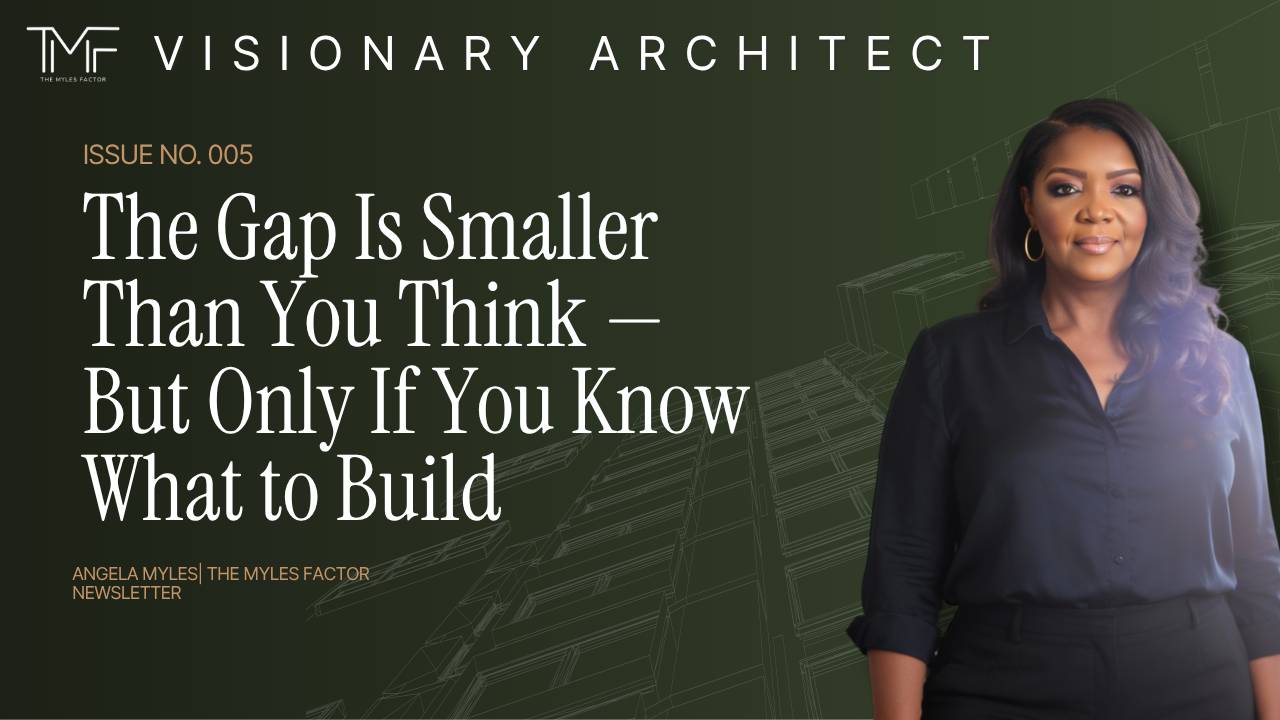
The Gap Is Smaller Than You Think — But Only If You Know What to Build
A note from Angela Myles, Chief Visionary Strategist
Last week I told you something that I want to sit with for another moment before we move forward.
I told you about the pattern — crisis creates visibility, visibility generates urgency, urgency releases resources — and I told you that the organizations positioned to receive what comes next are the ones building their infrastructure now. Not after the opportunity arrives. Before.
And I know what some of you thought when you read that.
You thought: that is not us. We are too far behind. The gap between where we are and where we need to be is too large to close before the next funding window opens.
I want to address that thought directly this week. Because it is almost always wrong.
The gap is smaller than you think.
Most leaders who feel behind in their organizational infrastructure assume the distance between where they are and where a funder needs them to be is years of work. A complete organizational overhaul. A level of documentation sophistication that only large, established nonprofits have.
That assumption is not accurate. And it is costing you.
Here is what I have watched across twenty-five years of working with faith-based organizations at every stage of development. The leaders who receive funding are not the ones with the most sophisticated programs. They are the ones who can answer five specific questions — clearly, specifically, and with documentation.
Five questions. That is the gap.
Not years of work. Not a complete organizational rebuild. Five questions — answered on paper, in the language funders speak — that shift your organization from a ministry that does good work into a program that a funder can evaluate, trust, and invest in.
Here are the five questions.
Before you read these, I want you to answer them honestly in your head as you go. Not aspirationally. Not based on what you intend to build. Based on what exists in your organization right now — on paper, in a document, accessible to someone who has never met you.
Who exactly does your program serve, and what specific criteria determine whether someone is eligible to receive your services?
Not a general population. A defined one. Not your community. The specific households, age ranges, income levels, or circumstances that qualify someone to receive what you offer. If a funder asked you this question and your answer is everyone who needs help — you have not answered it.
How does someone enter your program, and what happens in the first thirty days after they do?
A documented intake process. A clear sequence of what your organization does, in what order, when someone walks through the door. If this lives only in the memory of your most experienced staff member — it is not a process. It is a habit.
What services do you deliver, in what sequence, and how do you know they are working?
A service delivery model. The specific interventions, activities, or resources your program provides — described precisely enough that someone who has never seen your work could replicate it. If your program cannot be replicated without you in the room, it is not documented.
What does successful completion of your program look like, and how does someone exit?
An outcome definition. Not what you hope happens to the people you serve. What you measure, what you track, and what constitutes a successful result by your own stated standard. Funders fund outcomes, not intentions.
What data do you collect, and how do you measure your results against your original goals?
An evaluation framework. The specific data points, tracking tools, and reporting mechanisms that let you demonstrate impact over time. This is the piece that most faith-based organizations skip — and the piece that most funders weight most heavily.
Five questions. The organizations that answer all five clearly and specifically are the ones that get funded. The ones that answer them vaguely, or not at all, get a form letter.
This is the clarity you need to know. It is a diagnosis.
I want to be clear about something before we go further.
If you read those five questions and felt a familiar weight — the weight of knowing that your answers are somewhere between not yet and not on paper — I am not writing this to discourage you. I am writing this because I have watched leaders carry the burden of funding rejection as though it meant something about their calling when it meant something about their documentation.
Your calling is not in question. Your structure is.
And structure is fixable. Faster than most leaders realize. Not because the work is not real — but because the gap between running a program and having a fundable program is not years of work when you know what to build and in what order.
What this means for this spring.
We are in the preparation window right now. The funding that historically follows seasons of significant community need does not arrive immediately — it moves toward organizations that were already positioned when the urgency peaked. And being positioned does not mean being perfect. It means being documented.
It means those five questions have written answers. It means your intake process exists in a form someone else can follow. It means your outcomes are defined and your data is being collected — even at a basic level.
That is the work of this spring. Not launching something new. Not rebuilding from scratch. Documenting what already exists — in the language that allows what you are already doing to be seen, evaluated, and funded.
This is what we are building on April 28th.
The Built to Be Funded Workshop is an 90-minute working session designed for exactly this moment. Not theory. Not inspiration about what fundable programs look like. A working session where we apply the fundability framework directly to your organization — and you leave with a specific picture of where you stand on each of those five questions and a concrete next step for every gap we identify.
It is $27. The replay is included for a limited time. And what is happening inside the room on April 28th — the part that is only for people who attend live — has been ten years in the building.
Eight days. That is the runway between today and April 28th.
If you are carrying the weight of knowing the gap exists but not knowing exactly what to build — this is the session for that.
→ Register for Built to Be Funded — April 28th
https://www.thefundablechurch.com/built
The funding that is coming is not looking for the most passionate organizations. It is looking for the most documented ones. Those can be the same organizations — if the leaders inside them do the work of this season.
Build this spring. Fund this fall.
Angela Myles
Chief Visionary Strategist, The Myles Factor
themylesfactor.com
P.S. If you are not sure which of those five questions is your most urgent gap — register for the workshop. That is exactly what we are working through together on April 28th.