Issue No. 004| The Funding Is Coming. Will You Be Ready When It Does?
Apr 13, 2026
VISIONARY ARCHITECT · ISSUE NO. 004 ·
The Funding Is Coming. Will You Be Ready When It Does?
A note from Angela Myles, Chief Visionary Strategist
I want to say something this week that most people in ministry leadership are not talking about.
Not because they do not know it. But because it requires a kind of clarity that is hard to hold when everything around you is moving.
We are in the kind of season that does not just reveal need.
It reveals who is prepared to meet it.
What the current moment is actually telling us.
The families in your community are feeling it. Costs are rising in ways that are not temporary. Food insecurity is not a background issue — it is a front-door issue for churches across this country right now. The pressure on households is real, it is visible, and it is landing directly in the laps of pastors and ministry leaders who were already carrying more than most people know.
And underneath all of that pressure is something that most church leaders are not positioned to see yet — because when you are in the middle of responding to immediate need, it is hard to lift your eyes to the strategic horizon.
So let me do that for you this week.
Because what I am watching happen in this season is not just a crisis.
It is a setup.
What history has shown us about moments like this one.
I have spent twenty-five years working with faith-based nonprofits, community organizations, and visionary church leaders. And across that time I have watched one pattern repeat itself with remarkable consistency.
Every significant period of national difficulty — every season where families are under pressure, where community need becomes undeniable, where the gaps in our social systems become visible to everyone — is followed by a measurable expansion of the resources available to address it.
When the housing crisis collapsed in 2007 and 2008, it did not just displace families. It generated one of the largest waves of community development funding this country had seen in a generation. Federal programs expanded. Philanthropic foundations redirected their portfolios. Entire grant categories were created specifically to address what the crisis exposed.
The same pattern emerged during the veterans services crisis of the early 2010s. Awareness grew. Political will followed. Funding expanded toward organizations positioned to respond to housing instability, mental health access, and workforce reintegration.
It happened after the opioid crisis. It happened in the years following the social upheaval of 2020. Each time, the same sequence unfolded.
Crisis creates visibility. Visibility generates urgency. Urgency releases resources.
And in every one of those moments, the question was never whether the funding would come.
The question was always: who would be positioned to receive it when it did?
What broke my heart then — and is still happening now.
Here is what I watched play out across every one of those seasons. And it is the reason I am writing this to you today.
Churches saw the need. They felt the assignment. They had been faithfully serving their communities for years — running food programs, mentorship initiatives, support services that no government agency was reaching. They were called. They were committed. They were showing up every single week.
But when the funding came, they could not receive it.
Not because they lacked faith. Not because their vision was not real. Not because the need in their community was not documented and undeniable.
Because they did not have the structural infrastructure — the organizational container — that funders require before they release capital.
No documented program model. No measurable outcomes. No governance structure that existed separately from the church's general operations. No capacity to manage a grant budget, produce required reports, or demonstrate the compliance that federal and philanthropic funders demand.
And so the funding went somewhere else. To organizations that had built the container — even if their vision was smaller, even if their community presence was thinner, even if their genuine commitment to the people was less.
They were not rejected because they were not called. They were rejected because they were not positioned.
I do not say that to condemn those churches. I say it because I have watched faithful leaders carry that rejection as a spiritual verdict when it was actually a structural one.
And structural problems have structural solutions.
We are in another one of those seasons right now.
The need in your community is not abstract. The families walking through your doors are carrying real weight. And historically, what follows a season like this one is a significant release of philanthropic capital, federal investment, and public funding directed toward community organizations that are ready to respond.
The foundations are already watching. The funding cycles are already being shaped by what is happening in communities across this country. The organizations that will be able to access what is coming are the ones that are building their infrastructure right now — before the opportunity arrives, before the urgency of the moment creates pressure to move without a container.
The churches that built their structure before the 2008 funding wave caught the wave.
The ones that were still trying to build during it missed it entirely.
This spring is your building season.
What being positioned actually means.
I want to be specific here because organizational infrastructure can sound abstract until you understand what a funder is actually looking for when they open your application.
Being positioned means you can answer these questions with documentation — not just intention.
Who exactly does your program serve, and what criteria determine eligibility?
How does someone enter your program, and what happens in the first thirty days?
What services do you deliver, in what sequence, and how do you know they are working?
How does someone exit your program, and what does successful completion look like?
What data do you collect, and how do you measure outcomes against your original goals?
These are not complicated questions. But they require structured answers — answers that live in documents, not just in the institutional knowledge of your most experienced staff member.
The organizations that answer these questions clearly and specifically are the ones that get funded. The ones that answer them vaguely, or not at all, get a form letter.
What you told me this week.
Before I close this issue I want to address something you said directly.
This week in our Facebook community I asked a simple question: what is your single biggest funding challenge right now? Not the one you talk about publicly. The one that is actually keeping you up at night.
Sixty-seven leaders responded. Here is what came back.
32% — Getting grants approved
32% — Finding the right funders to apply to
17% — My organization is not ready to apply yet
9% — Keeping donors engaged and giving consistently
Eighty-one percent of the leaders who responded are living one of the first three challenges. And I want you to see something that connects all three of them.
You cannot get grants approved for a program that is not built to be funded. You cannot find the right funders without a fundable program to present to them. And if you know your organization is not ready yet — that is not a confession of failure. That is the clearest kind of clarity a leader can have.
All three of those challenges have the same solution. Not more grant writing. Not a better application. A better-built program — with the documentation, the structure, and the operational infrastructure that makes everything else possible.
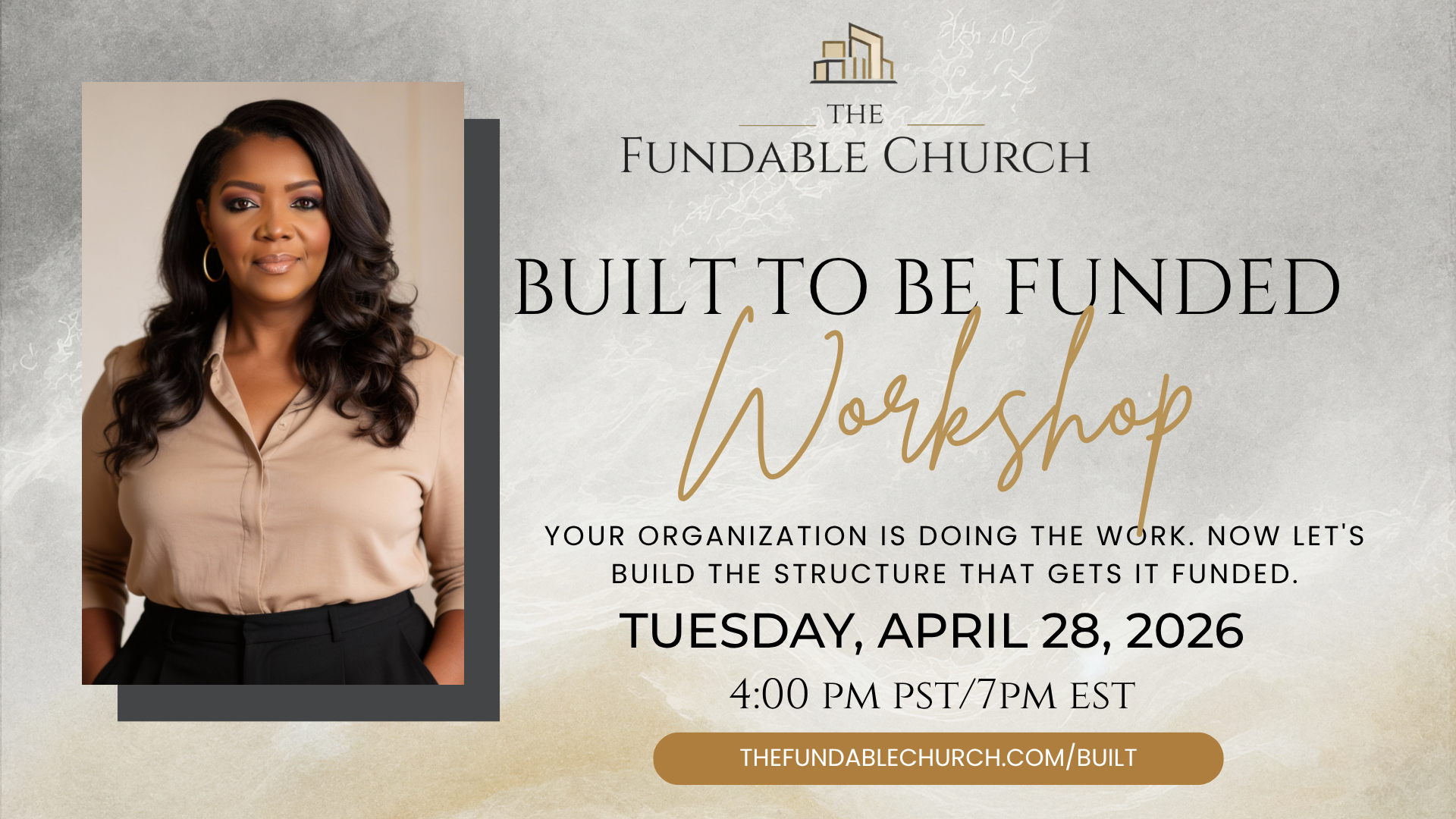
That is exactly what I am teaching on April 25th.
Built to Be Funded is a live workshop — one focused session where I walk you through the complete framework for building a church community program that is structurally sound, operationally documented, and positioned for the funding it deserves.
This is not a webinar. It is a working session. You will leave with a framework you can begin implementing immediately — not someday, not after another rejection, immediately.
Here is what we will cover:
- Why most church programs keep getting rejected — and it has nothing to do with the quality of the work
- The structural difference between a ministry and a fundable program — and how to close that gap
- How to document your program in the language funders actually speak
- The container question — which organizational structure your vision actually requires before you pursue funding
- Your specific next step — the one thing you build first based on where your organization stands right now
Saturday, April 25th. Live on Zoom. One session. Everything you need to stop circling and start building.
The investment is under $50 and your replay is included — so if you cannot make the live session, you still get the full framework.
→ Register for Built to Be Funded — April 25th
Here: www.thefundablechurch.com/built
If the poll results described where you are right now — this session was built for you. Register before the seats close.
Angela Myles
Chief Visionary Strategist, The Myles Factor
themylesfactor.com
P.S. The leaders who responded to this week's poll told me exactly where they are. If you are in that 81% — the ones struggling to get approved, find the right funders, or who know they are not ready yet — April 25th is your answer. Register now.