Issue No. 003| The reason your grant applications keep getting rejected isn't your mission.
Apr 05, 2026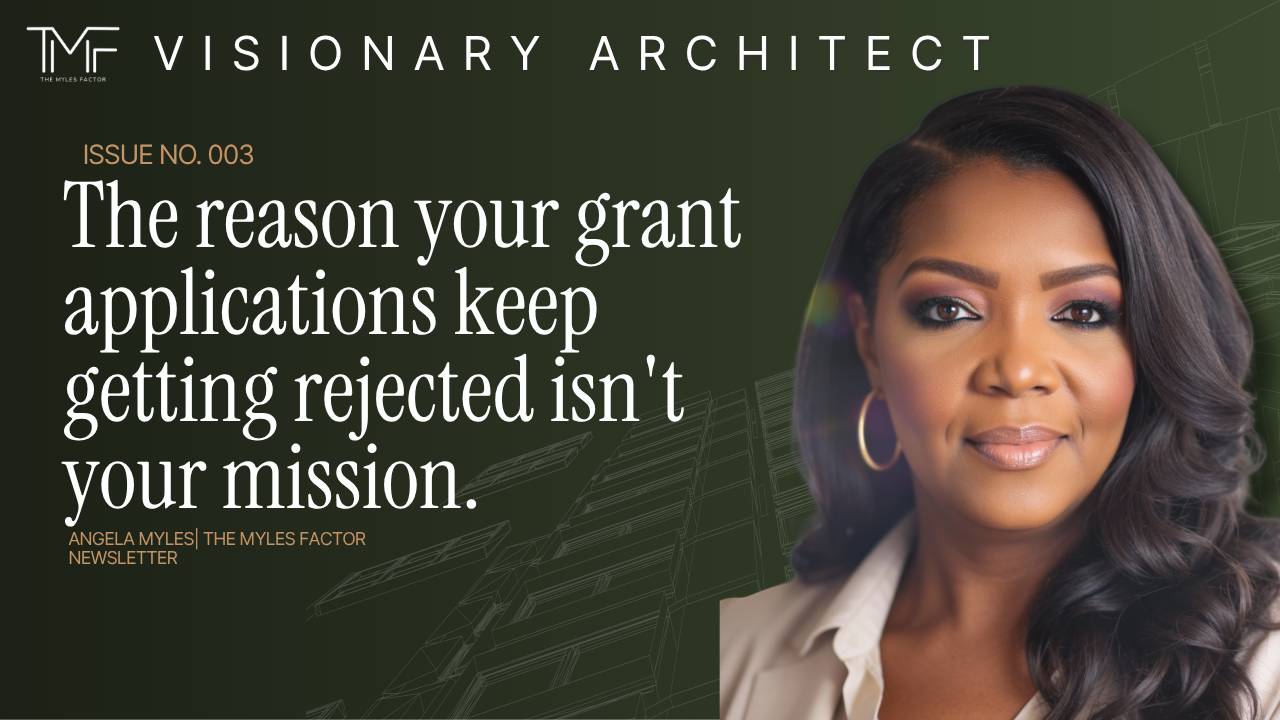
ISSUE No. 003| VISIONARY ARCHITECT
The reason your grant applications keep getting rejected isn't your mission.
Most faith-based organizations are not underfunded. They are unstructured.
That one sentence has changed the trajectory of every leader I have shared it with — because it moves the problem from God's provision to organizational readiness. And those are very different problems with very different solutions.
You prayed over that application. You wrote and rewrote the narrative. You submitted it believing this was the cycle things would change. And then the rejection came — again — with language so vague it told you nothing useful.
Here is what the rejection letter will never say: your mission was not the problem. Your infrastructure was.
Funders do not evaluate calling. They verify capacity.
Grant reviewers are not sitting across from your vision. They are sitting across from your documentation, your governance structure, your program frameworks, and your financial controls. Those are the signals that tell a funder whether your organization can responsibly steward the resources they release.
Vision is assumed. Structure is verified.
I have watched leaders with genuine Holy Spirit-backed assignments lose funding cycle after funding cycle — not because God was not in it, but because the organization was not built to receive it. There is a difference between being called to the work and being structured for the resources. Funders live in that difference. Most leaders were never taught it exists.
What fundable actually means
Fundable is not a personality. It is not about how well you can tell your story or how compelling your community impact sounds in a presentation. Fundable means a reviewer can open your organizational files and find what they are looking for — every time.
It means your board governance is documented. Your programs have measurable outcomes. Your financials are clean and current. Your policies reflect an organization that understands accountability.
When those things are in place, your mission does not have to work as hard. The structure speaks before you do.
A question worth sitting with this week
If a funder requested your organizational documentation today — not your vision statement, not your impact story, but your actual governance and program files — what would they find?
Not what you intend to have in place. What exists right now.
That gap between what you intend and what you can actually produce is your fundability gap. And it is the most honest measure of where your organization actually stands.
Next week we are going to talk about what that gap is costing you — in dollars, in cycles, and in the weight of carrying a vision that keeps outpacing your resources.
Until then — build with intention.
Angela Myles The Myles Factor | The Fundable Church
Helping faith-based leaders build organizations that are structured to receive what they are called to steward.
[P.S.] If this landed for you, forward it to one leader in your network who needs to hear it. The work we do together grows when the right people are in the room.